






York packs more history into its walls than almost anywhere else in England, and that abundance is exactly the problem for a first-time visitor.
A Roman fortress, a Viking trading city, a medieval cathedral and the birthplace of the modern railway all sit within a fifteen-minute walk of one another, which makes the real question not what to see but where to start.
This guide narrows the field to five experiences that, between them, give you the fullest picture of the city: one that frames the whole place at a glance, and four that reward a closer look.
It opens with the most relaxed way to get your bearings before the walking begins.
How this guide was put together
The selections below are the attractions that appear most consistently across York visitor itineraries and the city’s official tourism listings, chosen to balance the iconic with the genuinely useful – a mix of paid and free, indoor and outdoor, history-led and family-friendly.
Opening details, prices and features have been checked against each attraction’s own published information. Times and ticket prices change seasonally, so it is always worth confirming directly before you travel.
1. City Cruises York
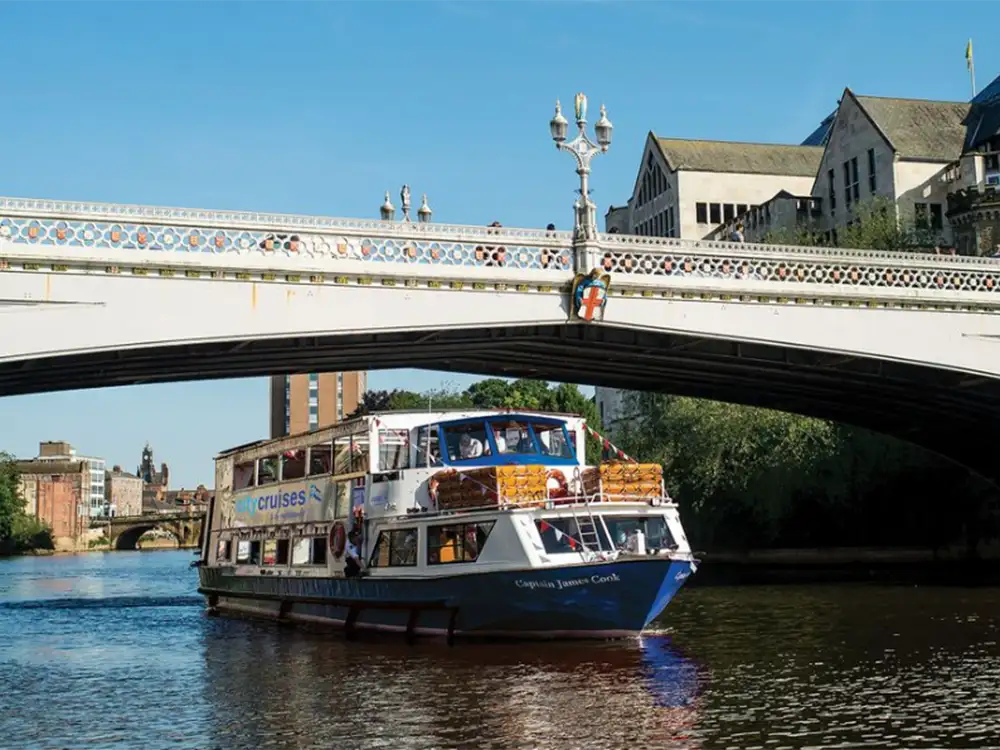
A river cruise is one of the best ways to see how the whole of York fits together. The city grew up around the River Ouse – Romans, Vikings and Victorians all built along it – and a sightseeing trip on the water takes in much of that story in a single sitting, making it a natural way to begin a visit before exploring the streets on foot. City Cruises York’s sightseeing trip runs for 45 minutes to an hour, departing from King’s Staith Landing in the city centre, with live commentary from the skipper covering the city’s Roman and Viking past and its long history of flooding. From the deck you pass landmarks that are harder to appreciate from street level, including York Minster, Clifford’s Tower, the Guildhall, the Museum Gardens and the city walls, framed by the Victorian bridges that span the river.
City Cruises York runs a fleet of several vessels, with both heated indoor saloons and open upper decks, and sailings run year round, switching to festive cruises in the run-up to Christmas. It is an easy choice for mixed groups: under-5s travel free, well-behaved dogs are welcome on the daytime sightseeing trips, and two of the boats are wheelchair accessible from King’s Staith. For visitors who want to stay on the water longer, there are also self-drive boats and evening cruises. Booking ahead is sensible in summer and during the school holidays, when sailings are busiest.
Best for: getting an overview of the city before exploring on foot.
Standout feature: seeing York’s riverside landmarks from the Ouse, with live history commentary.
Practical note: sailings can be affected by high river levels, so check on the day.
2. York Minster
York Minster is one of the great medieval cathedrals of England and the building most people picture when they think of the city. There has been a church on the site since the seventh century, and the present Gothic cathedral was built over more than two centuries from the 1220s, under Archbishop Walter de Gray’s ambition to create one of the greatest churches in the kingdom. It is home to the Great East Window, which the cathedral describes as the largest single expanse of stained glass in the country. The octagonal Chapter House, finished in the early 1290s, is a particular highlight: its vaulted ceiling is supported not by a central column but by timbers in the roof, an engineering technique that was unique at the time.
The Minster’s Central Tower is the highest point in York, and visitors who climb its 275 steps are rewarded with panoramic views across the city and countryside, though the tower climb carries a minimum age of eight and is best pre-booked as places are limited. General admission tickets range from £13 to £28 depending on what you include, and they come with a genuinely useful perk – each ticket is valid for a full calendar year, and up to four children aged 17 and under enter free with each paying adult. As a working cathedral open 365 days a year, sightseeing hours are shorter on Sundays around services, so it is worth checking the calendar before you go.
Best for: architecture, stained glass and city views from the tower.
Standout feature: the medieval stained glass and the 275-step Central Tower climb.
Practical note: York residents and students enter free with valid ID.
3. York City Walls
The York City Walls are the longest and most complete medieval town walls in England, and walking them is one of the best free things to do in the city. The route – often called the Bar Walls – forms an elevated circular walkway of around 3.4 kilometres (two miles) on top of earthen ramparts, a feature unique among English city walls. A full circuit takes most people between an hour and a half and two hours, though you can join and leave at any of the access points and walk just a section.
Along the way the walls pass through four great fortified gateways, known as bars: Bootham, Monk, Micklegate and Walmgate, the last of which is the only one of York’s bars to keep its medieval barbican intact. The stretch between Bootham Bar and Monk Bar – the closest to the centre – gives the most celebrated views of the Minster. The walkway is free and open daily from 8am until dusk, managed by the City of York Council, which closes sections in ice or high winds for safety. In spring, the grassy ramparts are well known for their displays of daffodils.
Best for: walkers, families and budget visitors.
Standout feature: elevated views over the city and the Minster, entirely free.
Practical note: the path is narrow and uneven in places and can be slippery when wet.
4. JORVIK Viking Centre
JORVIK Viking Centre stands directly above one of the most important archaeological finds in modern Britain. Between 1976 and 1981, excavations at Coppergate uncovered the remarkably preserved streets, houses and workshops of Viking-age York, and the centre was built on the site to bring those discoveries to life. The visit is best known for its ride, in which capsules carry you through a reconstruction of 10th-century Jorvik, recreating the sights, sounds and even the smells of the era, with figures speaking Old Norse.
Beyond the ride, the galleries display real artefacts pulled from the dig – metalwork, carved bone, and three Viking-age skeletons whose bones reveal where these people came from and how they lived – alongside the famously well-preserved Lloyds Bank Coprolite, a piece of fossilised Viking waste that has taught archaeologists a surprising amount about diet and health. Adult tickets start from £17.50, with children’s and family tickets available and under-5s free. The attraction operates timed entry slots, so pre-booking is strongly advised, particularly in school holidays. Most visitors find an hour is enough to see both the ride and the galleries.
Best for: families and anyone interested in Viking history.
Standout feature: the immersive ride through reconstructed Viking-age streets.
Practical note: the underground setting and strong sensory effects can be intense for very young children.
5. National Railway Museum
The National Railway Museum tells the story of the railways that York helped to build, and entry is free. Opened in 1975 as the first national museum to be built outside London, it is one of the largest railway museums in the world, and its halls hold the national collection of historic locomotives and rolling stock. The undisputed star is Mallard, the streamlined steam locomotive that set the world speed record for steam at 126 mph in 1938 – a record that still stands. Nearby sits the only Japanese Bullet Train outside Japan, which visitors can step aboard.
There is plenty to fill a half-day. The Great Hall and the recently reopened Station Hall display royal carriages and the engineering marvels behind everyday travel, while the Workshop lets you watch engineers restoring locomotives, and seasonal extras such as the Miniature Railway and a Flying Scotsman VR experience add to the appeal. The museum is a strong choice for families and has been recognised locally as both a leading family attraction and a top rainy-day option in York. It is open seven days a week, generally from 10am to 5pm, and although admission is free, booking online in advance can save time during busy periods. It sits just behind York railway station, a short walk from the centre.
Best for: families, engineering enthusiasts and wet-weather days.
Standout feature: record-breaking Mallard and the Japanese Bullet Train.
Practical note: free entry, with donations welcomed.
Making the most of a day in York
York is compact and largely pedestrianised, so most of these attractions are within a short walk of one another and a sensible plan depends more on who you are travelling with than on geography.
First-time visitors often do well to start on the water. A morning cruise gives you the lie of the land and points out landmarks you can then explore on foot, after which the walk between the river, the Minster and the Shambles is easy and scenic.
Families with children tend to get the most from JORVIK and the National Railway Museum, both of which are built around interactive experiences, with the free city walls offering a chance to let off steam between indoor stops.
History and architecture lovers could happily spend half a day at the Minster and the walls alone, pairing the cathedral’s interior with the elevated views of it from the Bootham-to-Monk Bar stretch of the walls.
Visitors watching the budget can build a genuinely full day from the free options – the walls and the railway museum – adding a modestly priced river cruise without stretching things.
Frequently asked questions
How many days do you need in York? A single full day is enough to see the headline attractions, since the city centre is small and walkable. Two days gives you a more relaxed pace and room for museums, shopping in the Shambles and time on the river.
What is the best free thing to do in York? Walking the city walls is one of the most popular free things to do – a circular route of around two miles that takes in fortified gateways, towers and some of the best views of York Minster. It isn’t the only no-cost option, though: entry to the National Railway Museum is free too, so visitors on a budget can fill much of a day without paying for admission.
Is York good for children? Yes. JORVIK Viking Centre and the National Railway Museum are both designed with families in mind, the river cruise welcomes under-5s free, and the open walkway of the city walls suits all ages.
What is there to do in York when it rains? The National Railway Museum and JORVIK Viking Centre are both indoors and have been recognised as strong wet-weather options, and York Minster offers hours of sheltered exploring across its galleries, museum and Chapter House.
What is York best known for? York is famous for its medieval cathedral, York Minster, its almost complete city walls, its Viking and Roman heritage, and its connection to the history of the railways – all of which feature in this guide.
Final thoughts
There is no single right way to spend a day in York, but a good one usually moves between the iconic and the unhurried. Start with the overview a river cruise gives you, then dig into the detail at the Minster, the walls, JORVIK and the railway museum as time and interests allow. Between them, these five experiences cover the city’s history from the Romans and Vikings to the age of steam – and leave most visitors planning a return trip before they have left.
The information in this article is general in nature and was correct at the time of writing. Opening times, ticket prices, sailing schedules and availability can change, and some attractions require advance booking. Visitors should check directly with each attraction before planning a visit.