





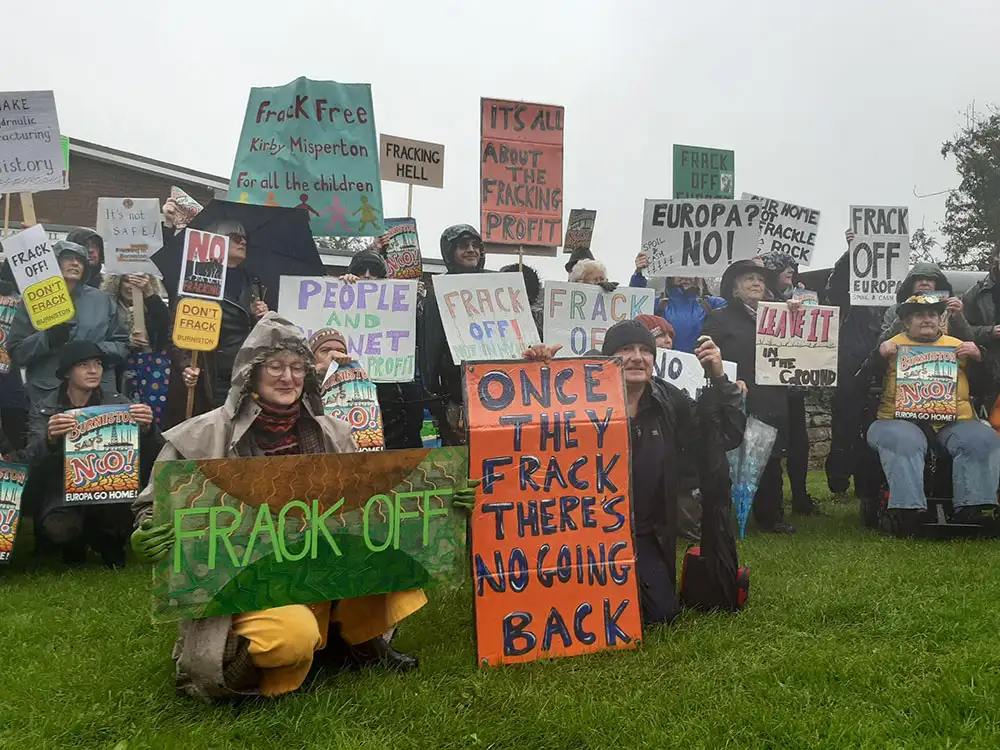

The Environment Agency has given the go-ahead for fracking in North Yorkshire.
It has granted a permit to Europa Oil and Gas Limited for a temporary exploration wellsite known as Cloughton 2 near Burniston, north of Scarborough.
That’s despite opposition from the Friends of the Earth, campaign group Frack Free Coastal Communities and many others.
The permit allows a process known as “proppant squeeze” – a smaller-scale type of fracking which is not covered by the moratorium on shale gas hydraulic fracturing.
Fracking, or hydraulic fracturing, is a method of extracting oil and gas from shale rock by pumping liquids deep underground at high pressures to release the gas trapped inside.
The Government ended its support for the practice in 2019 after an Oil and Gas Authority report found it was not possible to accurately predict the probability of earth tremors associated with the activities.
However, proppant squeeze is still allowed because it uses lower volumes of fluid and sand.
Triggered quakes
Geologist Stuart Haszeldine, of the University of Edinburgh, has outlined evidence that low-volume fracking activities in Lancashire in 2019 triggered earthquakes that were felt by nearby residents.
“Regulatory permission for low-volume fracking does not remove the risk of unpredictable earthquakes,” he said.
The Environment Agency says it only issues permits if it’s satisfied the operator can comply with the permit conditions and has appropriate systems in place to operate without causing harm to the environment, human health or wildlife.
Europa Oil and Gas’s proposals require planning permission, which was refused by North Yorkshire County Council.
It says it’s “assessing its options with a view to appealing the decision”.
Pat Kelly, environment agency area environment manager, said: “We recognise the significant public interest in this application and we have very carefully reviewed the comments and evidence from both public consultations.
“Our role is to assess whether the application meets the requirements of environmental legislation and whether the proposed activities can be carried out without unacceptable risks to people or the environment.
“Our assessment is evidence-based and there is a decision document which outlines how we reached our decision. I want to reassure people that the permit will ensure that robust levels of environmental protection are met.”