





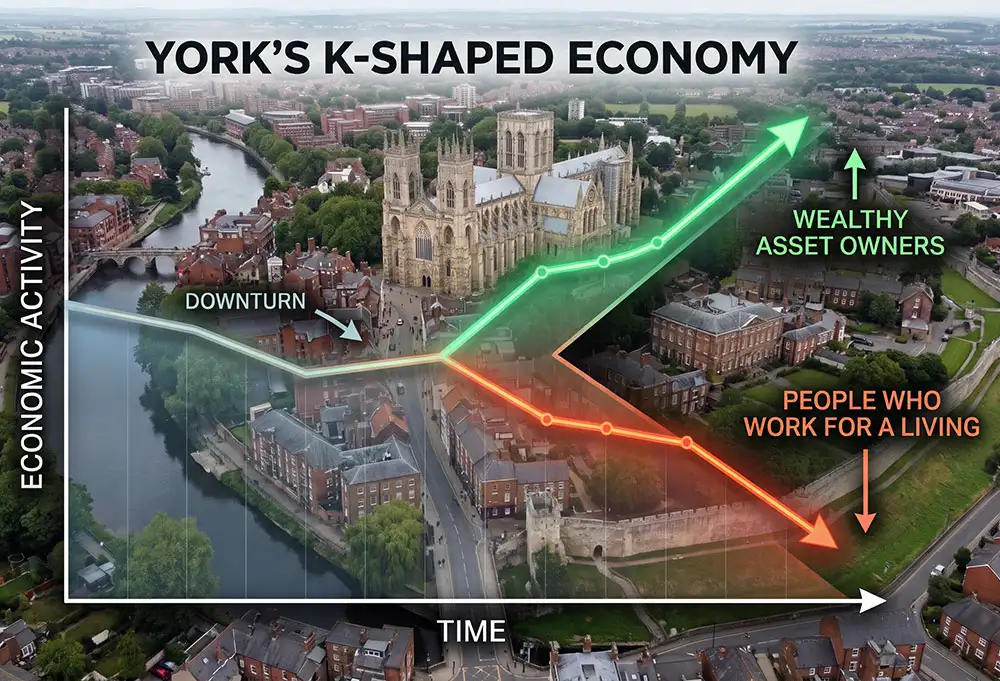

The council should create areas which ensure York’s workers have a better quality of life, writes Geoff Beacon
Economists now recognise we live in a “K-shaped” economy: The wealthy and very wealthy have income from the assets that they own, while the rest of the population must earn most of their income from working.
The wealthy, having increased income, are represented by the rising stroke of the K and the rest, relying on wages, by the falling stroke.
Over recent decades the wealthy have got much wealthier and the proportion of national wealth that goes to “workers” has fallen.
In the 1960s even the lower paid could accumulate assets, like buying a house. Now workers paid well above average salaries cannot afford to own their own home, certainly in many parts of the country, such as in York.
York’s Local Plan, confirmed in 2025, enhances this K-shaped trend by restricting the number of homes that can be built – and where they can be built.
This plan will support property prices to the benefit of owners of assets such as property or land.
In the case of land it is the right to build on land that creates its value. The value of land without the right of locating a building is very much smaller.
York’s 2025 Local Plan makes an allocation of land for housing, which is insufficient to slow the rise of property values in York. It tries to lock out further land use – particularly for housing – by designating most of the land it does not allocate as green belt.
This is to the advantage of existing homeowners and those who own land with planning consent for building.
I am pleased to see that green belt policy is under review by the City of York Council, and the York and North Yorkshire Combined Authority.
Keeping options flexible
At this time there are many sources of uncertainties: wars causing turbulence in global economies, the effects of artificial intelligence on jobs, and climate change affecting much more.
Any plan for York should be flexible to be resilient to these uncertainties.
This is why I suggest a policy that gives the council room for manoeuvre by acquiring land for sustainable development which can be quickly brought forward when necessary.
City of York Council can do little about war, the global economy or climate change – but it should have basic plans to address their effects. The 2025 Local Plan does not have enough flexibility.
Housing for the lower paid
Given the effects of AI on the job market, it is probable that the lower paid will not see much increase in their income. However, their quality of life could be enhanced by the provision of much less expensive housing.
Families of the lower paid have different needs for transport, shops and other services than more affluent families. Without being able to afford a car, the lower paid are much more dependent on public transport. They also need shops and services to be local.
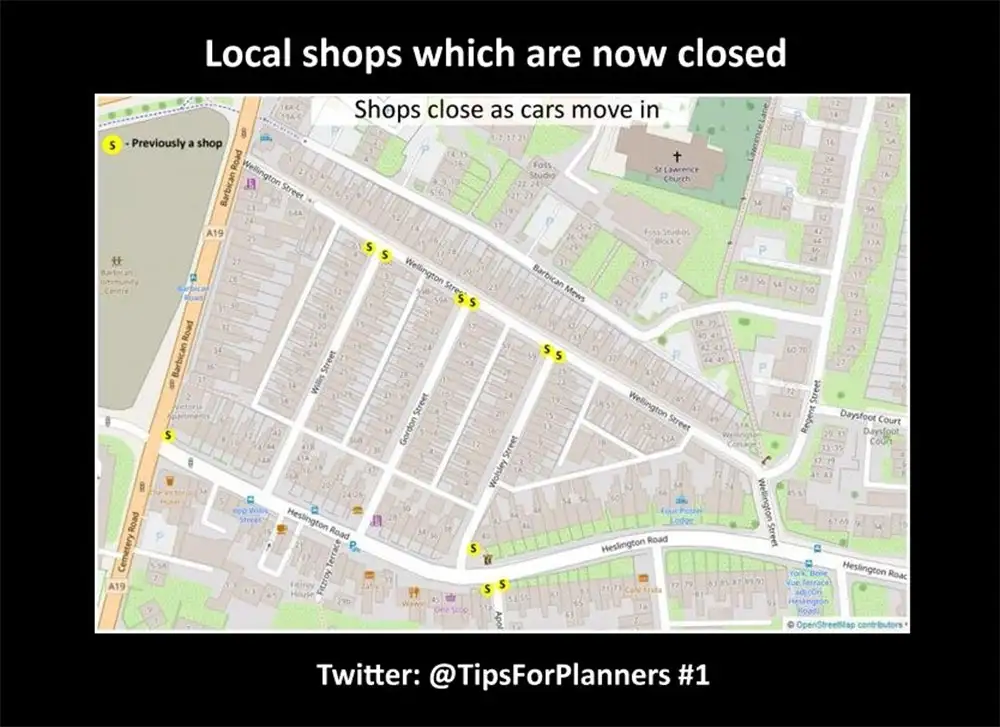
The Local Plan should have some areas of development that are car free, where public transport services, local shops and services can be viable.
Historically, as cars move in shops and services move out and public transport gets worse. I wrote about car free development in 1976 and also in 2018 (Car-free cities and pedestrian apartheid).
There has been a policy of planners to mix lower income residents with residents with the aim to de-concentrate poverty and build economically diverse communities.
However, an article in Social Life says:
One of our most striking findings is that most evidence on mixed housing dates back ten years or more. The smaller amount of more recent research tends to highlight negative effects for vulnerable residents. So even though mixed housing has become central to housing policy, evidence of its benefits is ambiguous.
I have also written on this topic in Mixed communities – a failed policy.